Ecstasy and Defiance
On Yasmine Hamdan, a REPRISE

That Yasmine Hamdan has released a new album after a long hibernation and is embarking on a European tour ought to shake the rest of us awake as well. I Remember I Forget is as haunting as I could have hoped for, filled with new and familiar instruments, rhythms, and tones. It took me back to the small number of times I heard her live, an enrapturing presence if ever there was one, including this night at Drom in New York, which was the first; originally published January 14, 2014. I will say that, regarding my indecision in the end, I am no longer uncertain: for all the aesthetic interest that an unfamiliar language can hold for the listener, I would choose, if I could, to understand it rather than not.
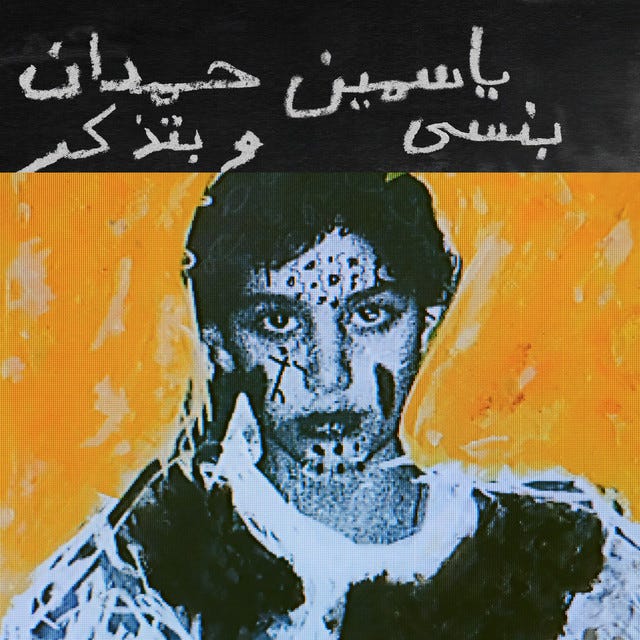
It can be a special gift to listen to a song in a language that you neither speak nor understand. A language has its own rhythms and tonalities, just as musical forms and genres do, and when there is singing, the musicality of language merges directly with that of the instruments. The deepest engagement with the aesthetics of song must involve the meaning of the lyrics, but there is something to be said for experiencing, as a child might, the isolate import of the sound alone.
Such was what happened to me on Monday night at Drom when I heard and saw Yasmine Hamdan. She is Lebanese and by all accounts an iconic figure of the Arabic underground who, now based in Paris, has embarked on a solo career that includes film as well as music. But she understands, as one who sings to English and French-speaking audiences, the ironies, paradoxes and potentialities of a language not understood. She prefaced one number with the wry admonition that the song, although it sounded like a love song, was in fact “about a politician”; to Arabic speakers or others in the know, the song might have been satirical, or in homage–I do not know and cannot say, but the effect, as she well knew, was of an emotive wave that rose before us and settled, in an attitude of profound reflection, on the shore.
Hamdan is lithely beautiful, and deeply sensuous, and most of her songs, so I gather, really are about sex and love; they deal–so she told us–with remembered acts of lovemaking and games of seduction. There is, beyond that, an ambiance of ecstatic joy, compounded in equal parts of pain and pleasure, that she quite consciously multiplies through her vocal and physical skills. She began the night gorgeously draped, in recognizably Middle Eastern shawls, only to doff them, revealing the flat belly, slinky frame, and tight jeans underneath. It was a triumph of sex over gender that sent a shot of pure desire through a packed venue. Her eyes sank into her face like those of the dead into their skulls, with the ironic defiance of the most potent of erotic come-ons. Yet she was never tawdry; hers was the poetry of the senses, not a crude giving in to transient instinct. There is a particular human being on the other side of her sounds, and an intelligence that is both sexual and sharp. In technical terms, she is astonishingly adept, using a double microphone for dramatic clarity (portraying the back-and-forth of an attempted seduction) as well as for musical effect; she cups her hand over her mouth, repeatedly, not to suggest the telling of a secret but to contain an emotion fully and release it with greater power.
Yasmine Hamdan has, in short, a grounded talent and an intoxicated humanity; to see her is to realize that spiritual freedom arises most convincingly from the secular and cosmopolitan. I do not know if she made me wish I understood Arabic or to hope that I never do; either way is fine with me; do not miss her when next she comes to town.