
The Undivided Voice
Cocteau in PARTS, a REVIEW of Barbara Hannigan's La Voix humaine

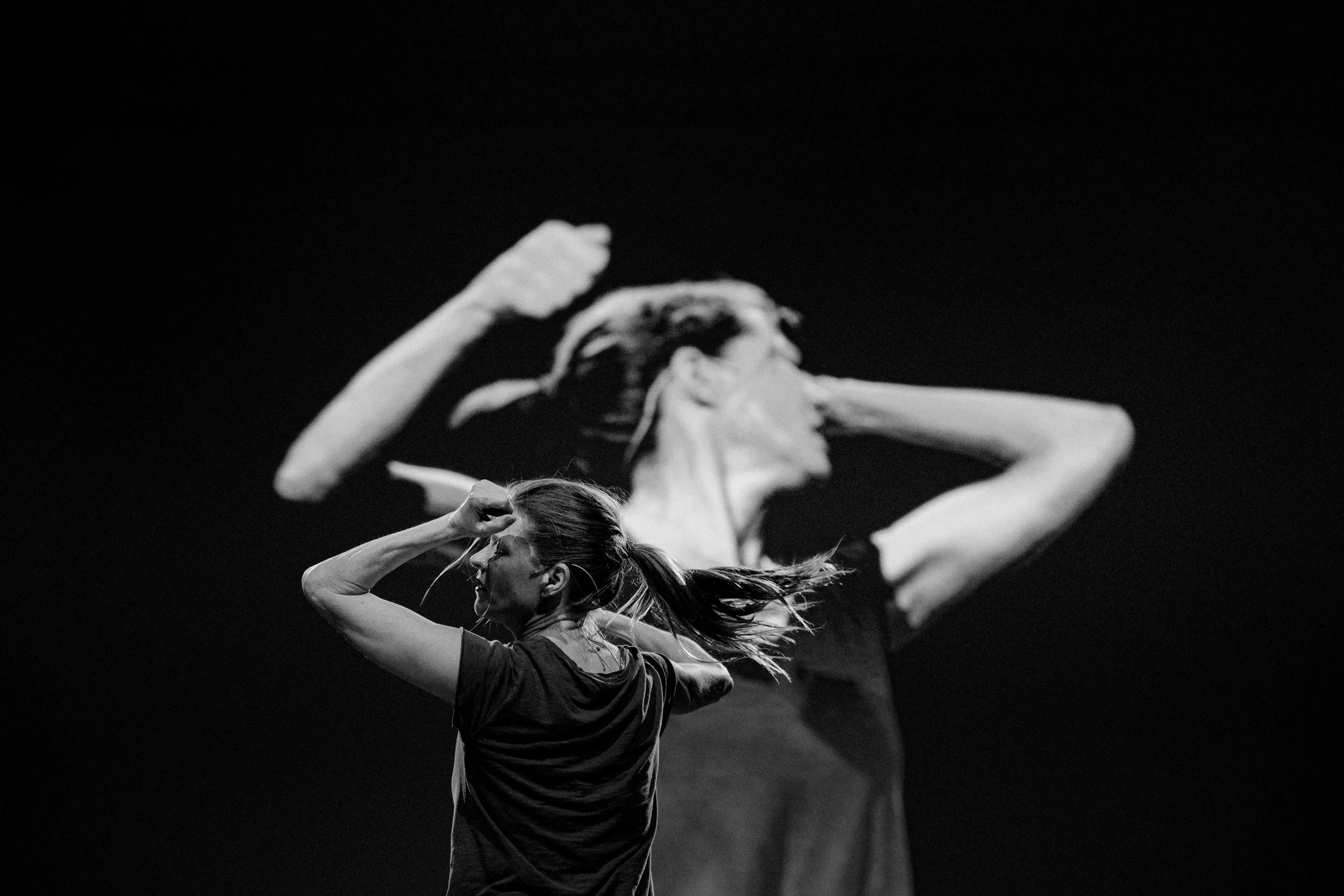
Jean Cocteau’s 1930 one-act play La Voix humaine casts a gauntlet before my project, in these pages, of reviewing parts of wholes. It is explicitly only part of the drama it enacts—one side of a telephone call—so it would do half the work for me. So, I imagine, would an ordinary production of Francis Poulenc’s 1958 opera of the play, although, to be sure, it adds music to the mix. Still, the fundamental interest of the situation is the minute focus on the voice of the woman, not knowing what the man at the other end says or, sometimes, whether he is there at all.
In 2021, the Canadian soprano and conductor Barbara Hannigan conceived a concert version of the opera that she would both conduct and sing—a bold promise of a tour de force, one kept last week with the New York Philharmonic at Lincoln Center. The common impression of the relationship between orchestra and singer, although the reality is more nuanced, is that the vocalist expresses the emotion of the music. Hannigan’s Voix inverts this, transmitting the emotions of the singer to the orchestra she conducts; the character’s gestures transform to the conductor’s, become one and the same.

In fact, she plays a multi-role. She is positioned normally on a platform but without podium, score, or baton, back to the audience, facing the orchestra on three sides. Facing her is a video camera, to which she acts in real time, her image in black-and-white, face and upper torso, mostly in close-up, on a screen at the back of the stage. That is what the audience sees: a full-body acting and conducting performance experienced almost entirely from behind, and the actor-singer onscreen, face-on, in role. And she sings, and her voice is everywhere.
Cocteau’s play-cum-libretto subtitles, in English translation, what is in effect a live movie that tells the story of a woman abandoned by a longtime lover on the other end of the line. She needs desperately to talk. La Voix humaine captured in its day how a technology of communication can frustrate communication itself, through crossed lines, dropped calls, the uncertainty of whether the person on the other end is even listening, the ease of lying without your face and manner exposing it, that infernal busy signal. Phones were all about the voice yet called it into question; it was no longer fully human, but mechanical; the telephone was the beginning of the mediated voice.
In putting half a conversation onstage, Cocteau critiques the technologically isolated voice while vindicating the value of hearing it directly. When the woman lies, or doesn’t know who is listening, or struggles with the technical inadequacy of the medium, we see it. The eye gives nuance to the ear.
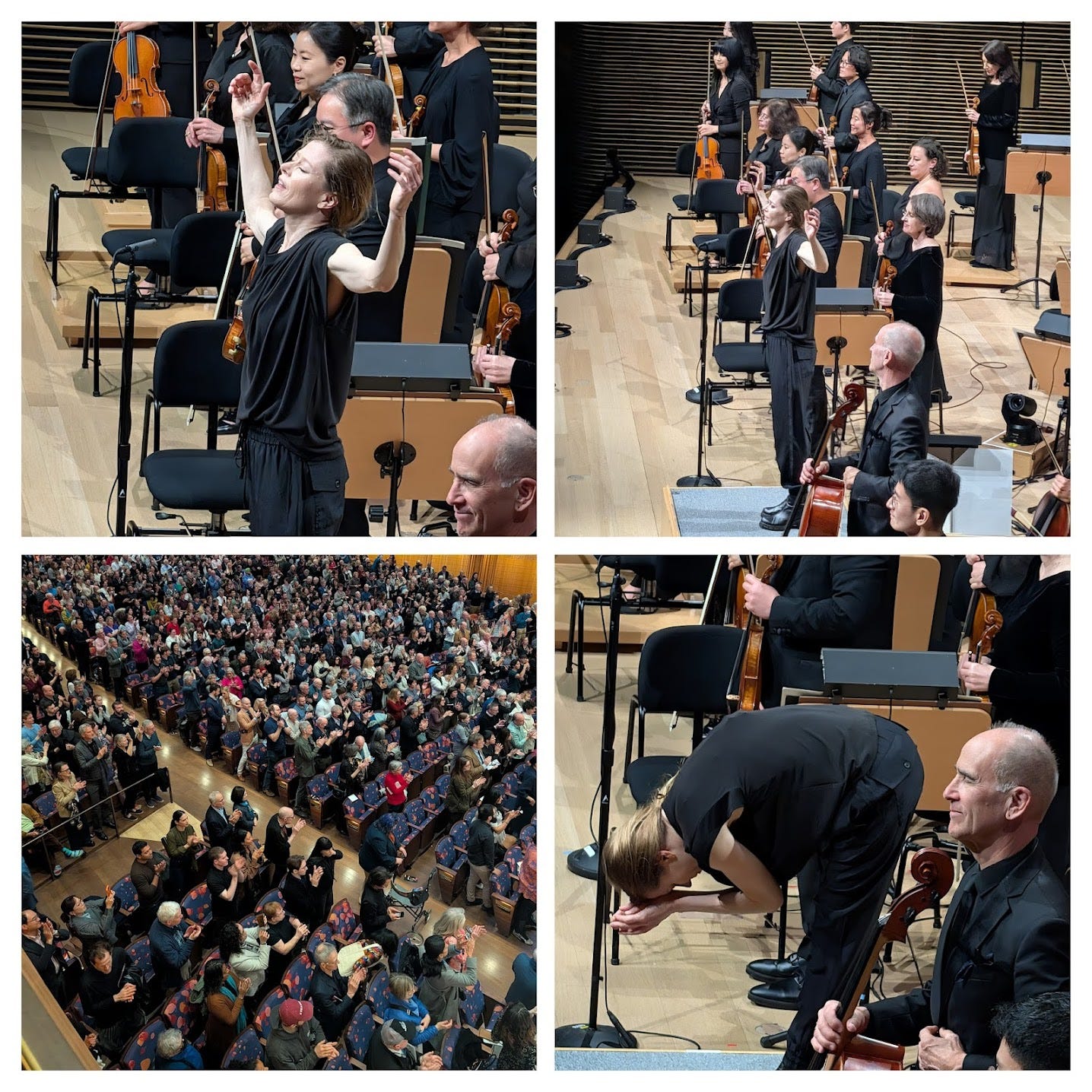
Poulenc flings Cocteau’s play into the dominion of the voice that is opera, and Hannigan, on the living stage, reminds us that modern technology alienates the body along with the voice, which inhabits it. Clemens Malinowski’s live videography isolates the face and the gestures of the torso; Hannigan’s feet and legs, obscured from the camera by the orchestra, are out-of-frame. To most of the audience, her body—lithe, limber, and expressive—foregrounds the giant video of the face they do not see, except during an important sequence when she turns to them, the subtitles continuing over a frozen gesture on the screen. She is a full-body actor, singer, and conductor, limbs supple as snakes, hands and arms like plants seeking the sun. It is almost a dance. Then there is the voice, which Hannigan liberates fully, its true listeners not the indifferent lover but we in the hall, universal and unmediated, not the voice of the woman on the phone but La Voix humaine—the Human Voice, unanimous, ours.
Clichés work sometimes, so I will say it. I have never seen anything like this. Hannigan’s tour de force—for she kept her promise—shatters Cocteau’s monodrama into its parts, from which emerges a single element, above and before the others, the universal instrument we bear in our bodies, the human voice, seeking hearers.