
Withering Slights
A TRIPLE REVIEW of Caveman in a Spaceship, Emily Brontë, and THAT movie

Recently in Brooklyn, I attended a live taping of Caveman in a Spaceship, a comedy act by Dave Hill and his band. I think that’s a reasonable description, although I could have called it a concert with banter gone uproariously wrong. Also recently, I fulfilled my sacred duty to see “Wuthering Heights,” realized that I had a false memory of having read the novel (sans inverted commas) and read it, therefore. The consumption of art being continual rather than discrete, I should have known that Emily Brontë, Emerald Fennell, and Dave Hill would be locked up together in my mind, but, not so obviously, that Hill would hold the key to it, putting upfront the truth that all three artists trade upon, which is that we are all, majorly or minorly, sadomasochists.
Insult comedy is sadism tamed, the self-pitying joke masochism released. Neither exists without the other. Don Rickles was, although Jewish, insult comedy’s patron saint. When his jokes fell flat, he compensated by offending the audience, sadistically, which they loved, masochistically. Rodney Dangerfield—“I don’t get no respect!”—was the king of comic self-depreciation. He could have passed as Rickles’ brother. Joan Rivers was in there somewhere, the smartest of the lot, turning insult and self-pity into bitingly feminist one-liners.

Which brings us to Dave Hill. I’ve seen Caveman in a Spaceship twice, first at (le) poisson rouge in Manhattan, then at the Bell House in the darkest forests of Brooklyn. I don’t think Hill entered and exited like a child on a bicycle in Manhattan, but he did at the Bell House. It’s self-infantilizing: he wants us not to respect him. So what? Respect has nothing to do with it. A banner was supposed to come down. It didn’t. Some poor functionary was responsible. Dave let him have it. It unfurled eventually, revealing a memorable slogan, which I’ve forgotten. He complains about the expensive dragon (yes, dragon). In one number, he suggests pick-up lines that will only work in New York. They’re corny but funny. He asks who’s from where in the audience; boy, are their hometowns in for abuse. He doesn’t spare his own: Cleveland (enough said). The stage is toilet-papered (it sticks to his feet, as it was designed to do), and he’s sprayed with soap bubbles. It’s as though someone mixed up the prop room with the bathroom closet. Introduce the band members? Nope. Sour and slighted, he slights others in return. They—we, for I was one of them—lap and laugh it up in return.

So, Caveman in a Spaceship (if the title was explained, I missed it) establishes for all time that we’re sadomasochists. Emily Brontë knew this in 1847. What struck me with force in reading Wuthering Heights was the casualness of its cruelty; when a litter of puppies is hanged, it’s a mere detail of the scene. Emerald Fennell’s movie opens with a man being hanged, his member aroused and teenage girls giggling at it, a perversely feminist rejoinder to Thomas Hardy’s confession that at age 16 he was attracted to the dangling body of a woman he saw hanged for killing her husband—as Tess of the d’Urbervilles would be in his most famous book. It’s a scene not to be found in Brontë, but the cruelties the novel does recount are so initially over-the-top that I laughed aloud. When one of the narrators, Lockwood, meets his landlord, Heathcliff, at Wuthering Heights, he might have wandered into a parody of family secrets and generational hatreds (it reminded me of Catherine Morland’s gothic fantasies in Austen’s Northanger Abbey). Everyone, except Lockwood and Nelly, the second narrator, treats everyone despicably, and they never stop doing so.
I wasn’t crazy about Rickles or Dangerfield. I think they rather meant the cruelty. Rivers may have too—but understood it. I won’t say Fennell is vindictively cruel or doesn’t know what she is doing. Her Saltburn was a far cannier exercise than “Wuthering Heights.” The obvious move here would be to say, the movie itself is a sadistic act. Okay: it’s a sadistic act. The hanging sets the tone, and there are other interpolations, including S&M paraphernalia and a wall made of human skin (at least, I think that’s what I was seeing). The rest is a meaningless blur. There’s supposed to have been a lot of sex, but if so, I forgot it as quickly as the slogan on Hill’s malfunctioning banner. In the novel, two generations of Catherines and Heathcliffs are caught in a generational cycle of pleasure-in-pain and pain-in-pleasure, call it attraction-repulsion, love-hate, or sex-death. Of course, there’s a lot more to Brontë than that, not least the interplay of psychology and the natural sublime. To “Wuthering Heights,” which prettifies the landscape and is short a generation, there’s a lot less.
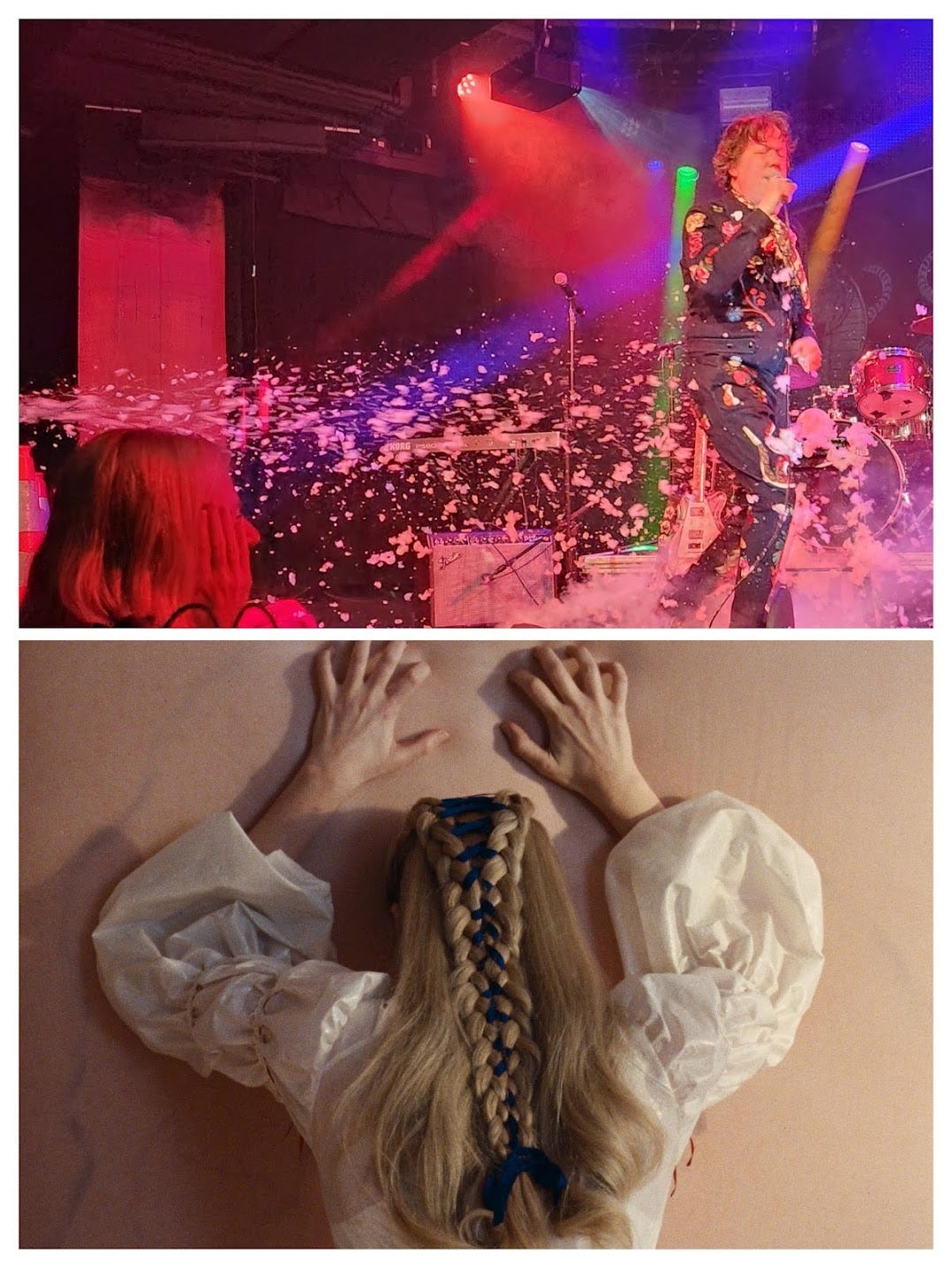
Still, I’m grateful to Fennell, without whom I might have gone naively to the end thinking I’d read a great novel when I hadn’t. I like having seen her movie more than I liked seeing it. I had no intention to write about it at all. I owe that to Dave Hill, whose mad amalgam of insult and self-pity drove me to it. He gets at these deeper things, but it’s all in good fun. He’s not really a sadist or even a masochist, more the Marquis of Sad.
You can keep tabs on the antics of Dave Hill here. Wuthering Heights is available at one or two of the few remaining bookstores. “Wuthering Heights” is playing at every cinema on the face of the planet. Check your local listings.
Maybe if Joan Rivers had been Cathy and Rodney Dangerfield Heathcliff, the film might have been more … amusing? Like Piss Christ and other self conscious pieces given to luxuriating in the ick, Fennell’s work repels and bores. Shock jock cinema. Loved the connections you make here.